MBDVidia
- Publish any native CAD to neutral MBD CAD file (QIF or STEP242).
- Use MBD data for downstream processes (FAI, CMM, etc.).
- Auto-capture annotations from any 2D PDF drawing.
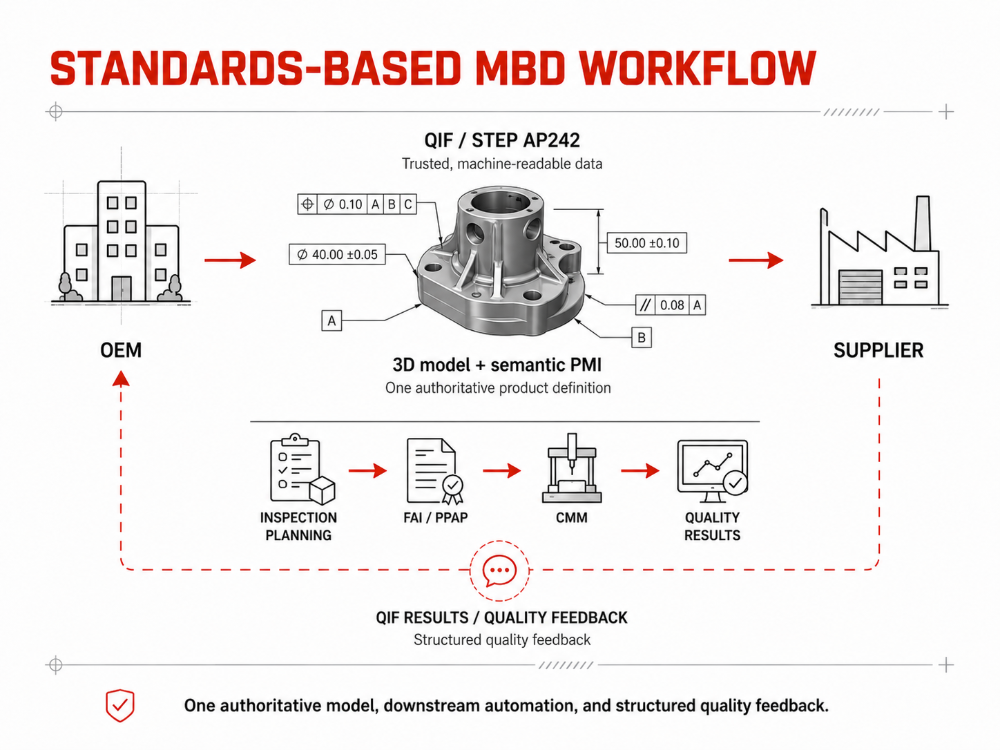
Model-based workflows ensuring human & machine-readable data for interoperability downstream between design, manufacturing, and quality.

No more ambiguity. No more interpretation. No more errors.
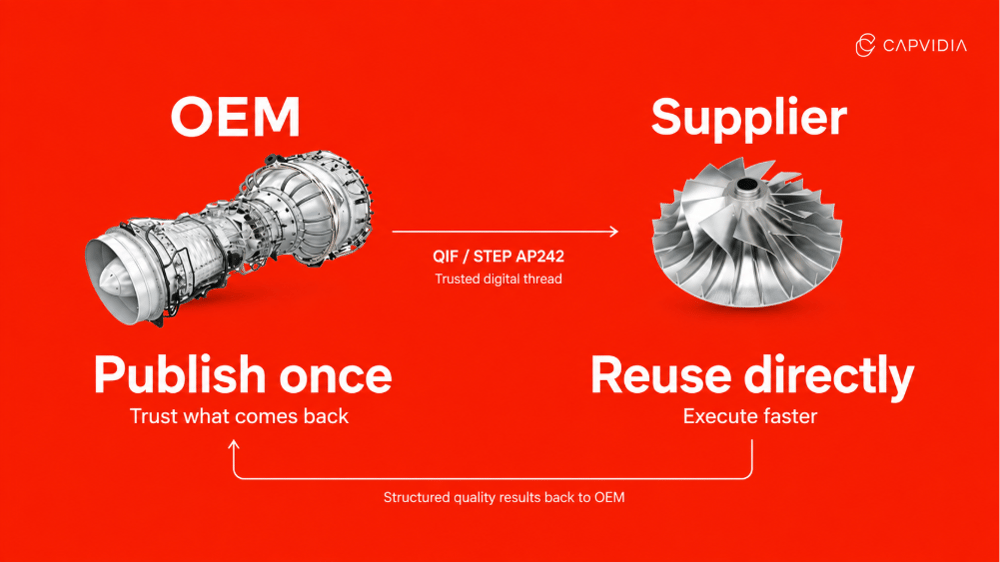
Standardize on human-and-machine-readable engineering content and connect the digital thread across OEMs and suppliers, so you can automate downstream work, eliminate rework, and accelerate release timelines.

Anyone can sell software, but do they provide end-to-end solutions like we've done for over 30+ years?
Our team works directly with your key team members to understand your workflows, solve your problems, and deliver tangible benefits.
Capvidia combines software, standards expertise, and hands-on implementation support, so your MBD initiative moves from pilot to production with confidence.
We've worked with Fortune 500 global OEMs and their supply chain, providing task-specific change to transform the entire product lifecycle.
MBD Ready means you can publish, consume, and validate machine-readable engineering intent—CAD geometry + semantic PMI + defined characteristics—so downstream teams and suppliers can build and inspect without ambiguity, rekeying, or rework.
Machine-readable MBD is MBD data stored as structured, semantic information (not just graphics). That lets software automatically extract PMI and characteristics to drive workflows like translation to QIF/STEP AP242, inspection planning, CMM programming, ballooning/BoC, and results reporting.
Capvidia helps you catch up by standardizing and validating MBD at the source, translating to neutral standards like QIF and STEP AP242, and enabling inspection-ready workflows with traceable results packages, so you can start with a pilot and scale confidently.
Quality Information Framework (QIF) creates a common, standards-based quality data layer for characteristics, plans, and results. It improves interoperability, reduces manual inspection prep, strengthens revision control, and makes FAI/inspection reporting more consistent and audit-ready across sites and suppliers.
Start with a small, measurable pilot. Define PMI/characteristic rules, validate every released model, publish to QIF/STEP AP242 for downstream use, and close the loop with an inspection-ready results package. Prove time/rework savings—then roll out the same playbook to more programs and suppliers.
Be the first to know about new software releases, conferences we're attending, and videos & presentations.